Table of Contents
ToggleCurtains do more than cover windows, they control light, add privacy, and set the visual tone for your entire living room. Whether you’re working with a sprawling bay window or a pair of standard double-hungs, the right curtain choice can make a cramped room feel taller, a cold space feel warmer, or a boring wall feel intentional. This guide walks through practical curtain ideas for living rooms, from fabric selection and color choices to hanging techniques and layering strategies. No fluff, just the details you need to pick, measure, hang, and style curtains that actually work for your space.
Key Takeaways
- The right living room curtain style—whether rod pocket, grommet, pinch pleat, or tab-top—determines both the visual tone and functionality of your space.
- Fabric choice directly impacts light control and durability; cotton and linen suit casual styles, while velvet and silk deliver a more luxurious, formal aesthetic.
- Proper hanging height (4–6 inches above the window frame or higher) and full panel width (1.5–2.5 times the window width) create a polished, intentional look.
- Layering curtains with blinds, sheers, or thermal liners adds depth, improves insulation, and gives you flexible control over light and privacy.
- DIY hacks like iron-on hem tape, fabric dye, clip rings, and repurposed hardware let you create custom living room curtain ideas on a budget.
Choosing the Right Curtain Style for Your Living Room
The style you choose dictates how formal or casual your living room feels, and it affects functionality too.
Rod pocket curtains are the classic option: fabric gathers along a sewn pocket that slides over the rod. They’re affordable and easy to find, but they don’t slide open smoothly, best for windows you don’t open often.
Grommet curtains have metal rings punched into the fabric, creating even pleats and a modern look. They glide easily on the rod, which makes them ideal for high-traffic windows or patio doors. Living room curtains modern in style often use grommets for that clean, minimalist vibe.
Tab-top or tie-top curtains offer a relaxed, cottage-style feel. The tabs or ties loop over the rod, creating visible gaps. They’re decorative but harder to open and close frequently.
Pinch pleat or tailored pleat curtains deliver a more formal, traditional look. Pleats are sewn in at the top, and they hang on hooks or rings. These work well in formal living rooms or spaces with high ceilings where you want a polished, custom appearance.
Eyelet curtains (similar to grommets but with larger, more visible rings) are popular in contemporary and industrial spaces. They’re functional and stylish, especially when paired with thick metal or wooden rods.
For a modern classy living room curtains approach, consider pairing tailored pleats with neutral tones and high-quality fabrics like linen or heavyweight cotton.
Best Curtain Fabrics for Function and Aesthetics
Fabric choice affects light control, durability, and how much maintenance you’ll be doing.
Cotton is affordable, washable, and widely available. It works for light filtering but isn’t the best for blocking light or insulating. Pre-washed cotton minimizes shrinkage, but expect some natural wrinkling.
Linen has a textured, relaxed look that fits modern and coastal styles. It drapes beautifully but wrinkles easily and can fade in direct sunlight. Linen blends (linen-cotton or linen-poly) offer better durability and easier care.
Polyester is budget-friendly, wrinkle-resistant, and holds color well. It’s often used in blackout or thermal curtains because it can be tightly woven. Pure polyester can look cheap up close, but blends with cotton or linen improve the hand feel.
Velvet provides excellent insulation and light blocking, plus it adds a luxe, soft texture. It’s heavier, so make sure your curtain rods and brackets can handle the weight. Velvet works well in formal or moody living rooms.
Silk and faux silk offer a high-end sheen and elegant drape. Real silk fades quickly in sunlight and requires dry cleaning: faux silk (usually polyester) mimics the look with easier care.
Sheer fabrics (voile, chiffon, organza) diffuse light without blocking it. They’re best layered over blinds or heavier drapes for daytime privacy and soft light.
For drapery ideas for living room spaces that need light control, consider blackout lining. Most fabrics can be lined with a blackout layer, giving you style flexibility without sacrificing function.
Color and Pattern Ideas That Make a Statement
Color and pattern choices can visually expand a room, introduce contrast, or tie together a color palette.
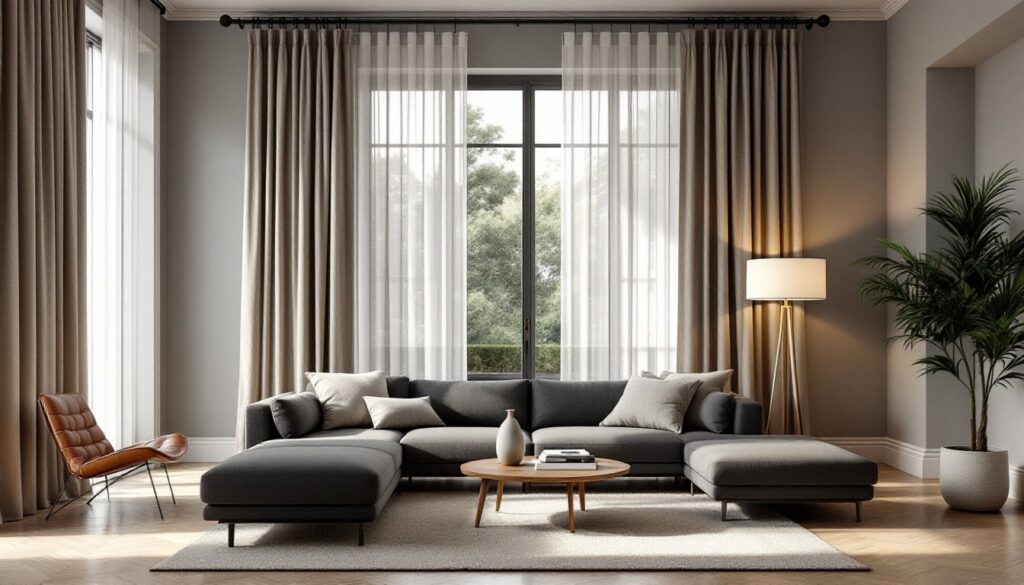
Neutral tones (white, cream, beige, gray, taupe) are safe and versatile. They work in any style and won’t clash with future furniture changes. For a modern curtains living room look, consider soft grays or warm taupes paired with matte black or brushed nickel hardware.
Bold colors (navy, emerald, terracotta, charcoal) add drama and anchor a room. Dark curtains can make a large room feel cozier, but they also absorb light, balance them with lighter walls or rugs. Jewel tones work well in eclectic or maximalist spaces.
Patterns should be chosen based on room size and existing decor. Large-scale florals or geometrics work in spacious living rooms with minimal other patterns. Small-scale prints or subtle textures (like a linen weave or faint stripe) suit smaller rooms or spaces with patterned furniture.
Stripes (vertical or horizontal) are a classic choice. Vertical stripes visually raise the ceiling: horizontal stripes can widen a narrow room. Keep stripe width proportional to your window size.
Two-tone or color-blocked curtains add visual interest without busy patterns. Pair a bold bottom panel with a neutral top, or use contrasting trim along the edges.
If you’re working with a neutral room, curtains are an easy place to inject color. Conversely, if your furniture or walls are bold, neutral curtains balance the space. Explore more curtain styling techniques to find what works for your aesthetic.
Curtain Length and Hanging Tips for a Polished Look
Improper length or hanging height is the fastest way to make expensive curtains look cheap.
Standard lengths are 63″, 84″, 96″, 108″, and 120″. Measure from where you’ll mount the rod to the floor, then choose the next size up. Custom hemming is an option if you need exact lengths, but most panels can be hemmed with fabric tape and an iron (no sewing required).
Hanging height should be 4″ to 6″ above the window frame, or even higher, up to halfway between the frame and ceiling. Mounting closer to the ceiling makes the room feel taller. For 8′ ceilings, mount 4″ to 6″ above the frame. For 9′ or 10′ ceilings, go higher.
Curtain width matters for fullness. Panels should be 1.5 to 2.5 times the width of the window for a gathered, full look. Skimpy panels that just cover the glass look unfinished. For a 60″ wide window, use at least 90″ to 150″ of fabric total (two 45″ to 75″ panels).
Puddling vs. floating vs. kissing the floor:
- Puddle (fabric pools on the floor by 2″ to 6″) is formal and dramatic but collects dust and pet hair.
- Float (curtains end ½” to 1″ above the floor) is practical for high-traffic areas or homes with pets.
- Kiss (fabric just grazes the floor) is the most common and polished look for living rooms.
Use a level when installing curtain rod brackets, uneven rods are immediately noticeable. For drywall, mount brackets into studs when possible: otherwise, use wall anchors rated for the weight of your fabric. Heavy velvet or lined drapes need stronger anchors than lightweight sheers.
If you’re updating window treatments in multiple rooms, measure each window individually, older homes often have slightly different window heights.
Layering Curtains with Blinds and Sheers
Layering gives you flexibility for light control, privacy, and insulation.
Sheer curtains over blinds is a popular combo. Use roller blinds or cellular shades for full blackout, then hang sheer panels on the rod for softness and daytime privacy. Sheers diffuse light without blocking your view, and you can close the blinds at night.
Heavy drapes over sheers is the classic layered look. Mount a double curtain rod (one rod set slightly forward of the other) or use curtain rings with clips. During the day, tie back the heavy drapes and leave the sheers closed. At night, close both layers for maximum insulation and light blocking.
Curtains over vertical blinds (common on sliding glass doors) can hide dated blinds and add warmth. Use a ceiling-mounted or wall-mounted track system that clears the blinds when pulled open. Make sure the rod extends far enough past the door frame so panels can stack off the glass.
Layering for insulation: Thermal or blackout curtains paired with cellular shades can reduce heat loss in winter and heat gain in summer. The air gap between the two layers adds an insulating buffer. For best results, mount curtains as close to the wall and ceiling as possible to minimize air leaks.
Design-wise, layering adds depth. Use contrasting textures (linen drapes over smooth roller shades) or complementary colors (cream sheers under charcoal drapes). Browse design inspiration for layering ideas that suit your style.
Budget-Friendly DIY Curtain Hacks
Custom curtains are expensive, but a few DIY tricks can give you high-end results on a budget.
Hem or lengthen panels yourself. Use iron-on hem tape (like Stitch Witchery) to shorten panels without sewing. For lengthening, sew or clip on a contrasting fabric band at the bottom or top, it looks intentional and adds visual interest.
Dye or paint curtains. White or light-colored panels can be dyed with fabric dye (Rit or Dylon) in a washing machine or large bucket. For patterns, try block printing with fabric paint and a stamp or stencil. Test on a scrap first: some synthetics don’t take dye well.
Add trim or embellishments. Sew or fabric-glue ribbon, pom-pom trim, or fringe along the leading edge or bottom hem. This transforms plain curtains into statement pieces. Use a hot glue gun for no-sew options, but hand-stitch for a more durable finish.
Make curtains from sheets or drop cloths. Flat bed sheets (especially linen or cotton) can be hemmed and hung as curtains. Canvas drop cloths from the hardware store work too, they’re sturdy, inexpensive, and have a natural texture. Hem the sides and add grommets or clip rings.
Use clip rings for no-sew hanging. Buy curtain rings with clips and attach any fabric, vintage tablecloths, fabric remnants, even lightweight quilts. This is great for renters or anyone who wants easy swaps.
Repurpose curtain rods. Copper pipe, galvanized conduit, or wooden dowels make industrial or rustic rods for a fraction of the cost. Pair with basic brackets or DIY brackets from pipe fittings. Sand and seal wood dowels to prevent snags.
For curtains ideas for living room projects on a budget, home decor communities for before-and-after inspiration and material sourcing tips.
Safety note: If dyeing or painting curtains, work in a ventilated area and wear gloves. Some fabric dyes and paints release fumes: follow product safety instructions.
Conclusion
Curtains are one of the most impactful and reversible changes you can make in a living room. With the right style, fabric, length, and installation, they can elevate a space, improve comfort, and solve practical problems like light control and privacy. Start by measuring carefully, choose fabrics that match your functional needs, and don’t be afraid to layer or DIY for a custom look on a budget.