Table of Contents
ToggleDesigning a commercial kitchen isn’t like picking cabinet colors for your home. It’s a high-stakes blend of workflow engineering, code compliance, and heavy-duty infrastructure, where a misplaced sink or undersized hood can cost you thousands in retrofits or failed inspections. Whether someone’s opening a café, catering business, or ghost kitchen, the layout determines how fast tickets move, how safe the crew stays, and whether the health department signs off. This guide walks through the structural and regulatory realities of commercial kitchen design, from zone planning and equipment clearances to ventilation loads and permit hurdles. No fluff, just the dimensions, codes, and decisions that separate a functional prep line from an expensive mess.
Key Takeaways
- Commercial kitchen design requires NSF-certified materials, code compliance (IBC, health codes, NFPA 96), and fire suppression systems that differ fundamentally from residential kitchens.
- A successful commercial kitchen layout prioritizes workflow efficiency through zone planning (receiving, cold storage, prep, hot line, plating, dishwashing) with proper aisle widths (44–48 inches minimum) and equipment clearances.
- Ventilation sizing must match cooking heat output precisely—a 36-inch gas range needs roughly 900 CFM of exhaust—and paired with makeup air units to prevent negative pressure and code failures.
- Budget $75,000–$150,000+ for a 600 sq ft kitchen buildout, and plan 3–4 months for permits and inspections; hiring a commercial kitchen consultant upfront ($100–$200/hr) saves thousands in rework and code violations.
- Critical compliance elements include handwashing stations (within 25 feet of prep), grease trap sizing, floor slope (⅛–¼ inch per foot), and GFCI protection; undersized or missing systems trigger failed inspections and costly retrofits.
- Cost-saving strategies—used NSF equipment, phased utility upgrades, shared commissaries, and modular stainless tables—maintain functionality without sacrificing code compliance or safety.
What Makes Commercial Kitchen Design Different from Residential Kitchens?
The gap between a home kitchen and a commercial kitchen layout isn’t just scale, it’s structural, mechanical, and legal. Residential kitchens handle a few meals a day: commercial setups run eight-plus hours under health department scrutiny, fire marshal inspections, and ADA access rules.
Material and Equipment Standards
Commercial kitchens require NSF-certified stainless steel surfaces, grease-rated exhaust hoods, and floor drains with grease traps. A typical home range draws 30–50 amps: a commercial six-burner with griddle can pull 60–100 amps on a dedicated 208V or 240V circuit. Gas lines jump from ½-inch residential to 1-inch or larger, and water supply shifts from ½-inch to ¾-inch copper or approved PEX to handle high-flow pre-rinse spray valves.
Code and Permit Requirements
Most jurisdictions mandate separate permits for plumbing, electrical, mechanical (HVAC), and building changes. The International Building Code (IBC) and local health ordinances dictate minimum aisle widths (typically 42–48 inches in cook lines), handwashing sink placement (within 25 feet of food prep), and non-slip flooring (quarry tile or sealed concrete with slip-resistance ≥0.60 DCOF). Residential permits rarely touch those details.
Fire Suppression and Ventilation
Commercial hoods need Type I (grease) or Type II (heat/steam) systems with automatic fire suppression, usually an ANSUL or equivalent wet-chemical setup tied to gas shutoffs. Residential range hoods just exhaust: commercial systems must meet NFPA 96 and match appliance BTU/heat output to CFM ratings. A standard commercial hood pulls 300–600 CFM per linear foot.
Spatial and Workflow Demands
Commercial kitchen design layout prioritizes throughput: dedicated zones for receiving, storage, prep, cooking, plating, and dishwashing. Cross-contamination barriers (separate sinks for produce, meat, and utensils) and cold-chain compliance (walk-ins holding 35–38°F) are non-negotiable. No home kitchen juggles that choreography or liability.
Essential Layout Principles for Maximum Efficiency
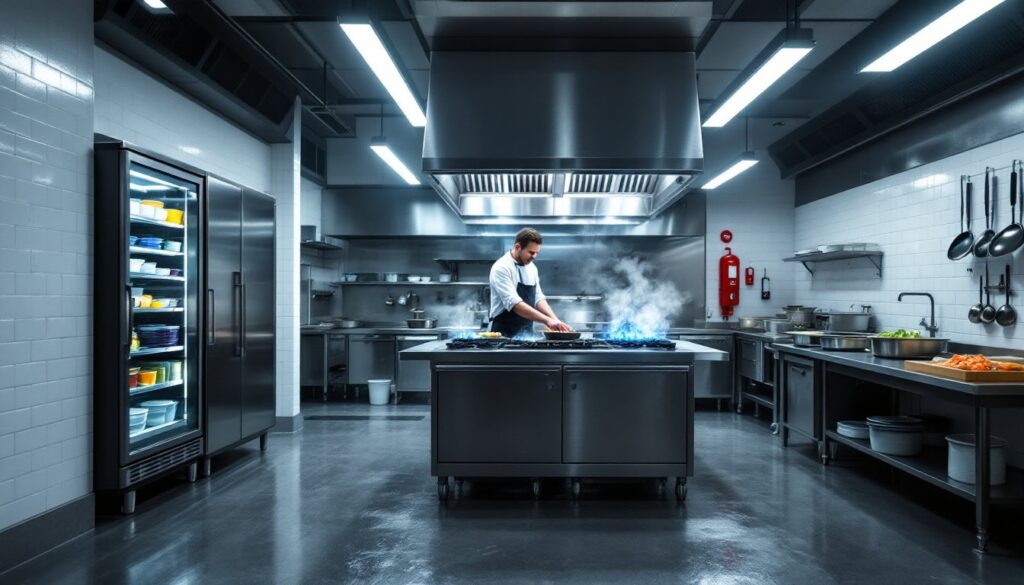
A commercial kitchen layout plan is a production flowchart rendered in stainless steel. The goal: move ingredients from delivery to plate with minimal backtracking, bottlenecks, or code violations.
Common Layout Archetypes
- Assembly-Line (or Island): Cook line runs down the center: servers grab from one side, cooks work the other. Works in high-volume fast-casual or diner setups.
- Zone (or Galley): Stations line parallel walls with a central aisle. Compact and efficient for very small restaurant kitchen design where square footage is tight.
- Open Kitchen: Cooking visible to diners. Requires extra attention to aesthetics, noise, and exhaust capture, hoods must be oversized to prevent smoke drift into dining areas.
- Ergonomic (or Modular): Pre-fab stainless modules (hot line, cold line, dish pit) that dock together. Common in ghost kitchens or commissaries.
Platforms like Houzz showcase real-world commercial layouts, though the details, gas drops, drain slopes, hood clearances, live in the spec sheets, not the photos.
The Work Triangle and Zone Planning
Borrowed from residential design but tighter: the classic triangle connects cooktop, sink, and storage. In a commercial kitchen simple restaurant kitchen layout, it expands into zones:
- Receiving/Dry Storage: Near the loading door. Shelving at least 6 inches off the floor (health code), labeled for FIFO rotation.
- Cold Storage: Walk-in coolers and freezers. Place near prep to cut walk time: allow 36-inch door swing clearance and a floor drain inside for defrost cycles.
- Prep: Stainless work tables (30×60 or 30×72 inches typical), with sinks and cutting boards. Plan 18–24 inches of table edge per cook during peak.
- Hot Line: Range, fryer, griddle, charbroiler, all under a Type I hood. Leave 6 inches between gas appliances and combustibles: 18 inches to walls for service access.
- Plating/Expo: Pass shelf or heated holdingcabinets. Position between kitchen and service staff.
- Dishwashing: Three-compartment sinks (wash/rinse/sanitize) plus a separate pre-rinse station. Each compartment minimum 12×12×10 inches deep. Many small restaurant kitchen layouts squeeze a commercial undercounter dishwasher here, allow 24 inches clear in front for rack loading.
Aisle Widths
IBC generally requires 36-inch minimum: 44–48 inches is safer when two cooks pass with hot pans. ADA mandates 60-inch turning radius if public or employee accessibility applies.
Equipment Selection and Placement Strategies
Choosing gear isn’t browsing a catalog, it’s matching BTU loads, electrical phases, and footprint to both menu and infrastructure.
Gas vs. Electric
Gas offers instant heat control and lower operating cost where natural gas is cheap: electric avoids venting complexity but spikes utility bills. A six-burner gas range might need 150,000–180,000 BTU/hr and a 1¼-inch gas line. An equivalent electric range pulls 17–20 kW on 208V three-phase, verify panel capacity before ordering.
Sizing to Volume
Over-spec and you waste energy: under-spec and tickets back up. A rule of thumb: 1 cubic foot of refrigeration per meal served daily. A 50-seat café serving 150 covers needs roughly 150 cu ft (a 48-inch reach-in plus under-counter units).
Clearances and Service Access
Manufacturers specify clearances in the install manual, typically 6 inches at sides, 6 inches at rear, and 18–24 inches in front for door swing or basket removal. Fryers and combi ovens need floor drains within 6 feet for boil-out waste.
Ventilation Matching
Every BTU or watt of cooking heat needs corresponding CFM. A 36-inch gas range (120,000 BTU) under a standard Type I hood requires roughly 300 CFM per linear foot × 3 feet = 900 CFM minimum. Undersized hoods fail inspection and smoke out the kitchen. For ideas on integrating design elements without sacrificing function, check out approaches to wall finishes that balance hygiene and aesthetics.
Mobility and Modularity
Wheeled equipment (mixer tables, sheet-pan racks) with locking casters adds flexibility. Quick-disconnect fittings (gas, water) let you rearrange without re-plumbing. Modular stainless tables with undershelf storage maximize vertical space in a small restaurant kitchen layout.
Health, Safety, and Code Compliance Requirements
No inspector cares how pretty the tile is if the handwash sink is missing or the grease trap is undersized. Code compliance isn’t optional: it’s the bedrock of how to design a commercial kitchen that opens, and stays open.
Handwashing Stations
Each prep area needs a dedicated handwash sink within 25 feet, with hot/cold mixing valve, soap dispenser, and paper towels. It can’t double as a mop sink or food-prep sink, inspectors check.
Food-Contact Surfaces
All prep tables, cutting boards, and shelving in contact with food must be NSF-listed stainless steel, food-grade plastic, or sealed wood (butcher block is allowed in some jurisdictions if maintained). Unsealed wood, cardboard, or painted surfaces fail inspection.
Floor Drains and Slope
Floors slope ⅛ to ¼ inch per foot toward drains to prevent standing water. Quarry tile or sealed concrete with coved base (4–6 inch radius) at walls is standard. Grease traps (interceptors) must be sized to half the kitchen’s total drainage fixture units (DFU), consult a licensed plumber and local code.
Fire Suppression
Type I hoods require an automatic suppression system (wet-chemical, linked to a manual pull station and gas shutoff) per NFPA 96. Installation and six-month inspections must be done by certified techs. DIY fire suppression is not a thing.
Electrical and GFCI
NEC 210.8 mandates GFCI protection for receptacles within 6 feet of sinks. Commercial appliances often run on 208V or 240V three-phase: verify panel capacity and hire a licensed electrician for new circuits. Aluminum wiring and undersized breakers are red flags.
ADA and Accessibility
If employees with disabilities work the line, or if the kitchen is public-facing (cooking classes, open-kitchen dining), ADA applies: 34-inch max counter height at accessible stations, 60-inch turning radius, and lever handles on doors and faucets.
Permitting Timeline
Plan review can take 2–6 weeks: inspections (rough plumbing, electrical, mechanical, final) add another 2–4 weeks. Budget 3–4 months lead time before the first ticket fires. Trying to retrofit after rough-in wastes time and money.
Ventilation, Plumbing, and Utility Considerations
The stuff behind the walls determines whether the kitchen runs smoothly or becomes a sweat-box with clogged drains and tripped breakers.
Exhaust and Makeup Air
Type I hoods exhaust grease-laden vapor: makeup air (MAU) units replace it so the kitchen doesn’t go negative-pressure (which sucks conditioned air from dining areas and slams doors). A 1,200 CFM hood needs roughly 1,000–1,200 CFM makeup air, tempered in cold climates to avoid freezing cooks. MAU units tie into the HVAC permit.
Ductwork and Roof Clearance
Ducts must be 16- or 18-gauge welded steel, sloped ¼ inch per foot back to the hood, with a grease cup or drain. Roof discharge needs 10-foot clearance from air intakes and property lines per IMC. Horizontal duct runs invite grease buildup, keep them short.
Grease Trap Sizing
Local code dictates gallons-per-minute (GPM) rating. A typical small restaurant kitchen needs a 20–50 GPM trap. Undersized traps clog: oversized traps cost more and still need monthly pumping. Trap must be accessible, buried under concrete is a rookie mistake.
Hot-Water Capacity
Three-compartment sinks need 110°F rinse water: many codes require 120°F minimum. A 40-gallon residential water heater won’t cut it, commercial kitchens need 50–80 gallon tanks or on-demand units rated for continuous 3–5 GPM at 120°F. Tempering valves prevent scalding at handwash sinks.
Gas Line Sizing
Add up all appliance BTU inputs, multiply by 1.2 (safety margin), then use a gas-pipe sizing chart (available in the International Fuel Gas Code). A 300,000 BTU load on a 50-foot run needs roughly 1¼-inch black iron pipe. Flexible CSST is allowed in some areas but requires bonding per NEC.
Electrical Panel Upgrades
Commercial kitchens often need 200–400 amp service. If the building panel maxes out, budget $3,000–$8,000 for a service upgrade (utility company, meter, panel, and inspection). For insights on optimizing limited spaces, explore strategies in cabinet layout planning that apply to both residential and commercial settings.
Floor Drains
Place one under the dishwasher, one near the three-comp sink, and one in the walk-in cooler. Use 3-inch or 4-inch drains with removable strainers. Slope floors and use stainless channel drains in cook lines to manage spills.
Budget Planning and Cost-Saving Tips
Commercial kitchen design layout isn’t cheap, but smart planning and phased spending keep it from spiraling.
Rough Cost Breakdown (Per Square Foot)
- Buildout (walls, flooring, paint, coved base): $30–$60/sq ft
- Plumbing (sinks, drains, grease trap, gas lines): $40–$80/sq ft
- Electrical (panel, circuits, lighting): $20–$50/sq ft
- HVAC/Hood (exhaust, makeup air, fire suppression): $50–$120/sq ft
- Equipment (new): $25,000–$100,000+ depending on menu
A 600 sq ft commissary might run $75,000–$150,000 all-in: a full-service restaurant kitchen can hit $200,000–$500,000.
Where to Save Without Cutting Corners
- Used Equipment: NSF-certified used ranges, fryers, and tables cost 40–60% less. Inspect for worn gaskets, rusted frames, and check model numbers against recall lists.
- Phased Utility Upgrades: Install rough plumbing and electrical for future expansion, but defer non-critical appliances (a second fryer, combi oven) until revenue justifies it.
- Shared Commissaries: Renting kitchen time ($20–$50/hr) lets startups test concepts before capital outlay. Sites like The Kitchn and Homify feature commissary case studies and layout inspiration.
- DIY Demolition and Prep: Pull permits for structural/MEP work, but handle demo, painting, and finish carpentry in-house if skilled labor is available.
- Modular vs. Custom Stainless: Pre-fab stainless modules ship faster and cost less than custom-welded tables. Sacrifice perfect fit for speed and budget.
Avoid These Budget Traps
- Undersizing utilities (re-work is expensive).
- Skipping the grease trap (failed inspection delays opening).
- Buying appliances before finalizing the layout (wrong dimensions = returns and restocking fees).
- DIY fire suppression or hood install (liability and code violations).
Financing and Incentives
SBA 7(a) loans cover kitchen buildouts: energy rebates (local utility companies) apply to Energy Star fryers, HVAC, and LED lighting. Check DSIRE database for state incentives. Budget 10–15% contingency for change orders and permit surprises.
Hiring a commercial kitchen consultant ($100–$200/hr) upfront can save thousands in rework, they’ll spot code issues, optimize workflow, and negotiate with equipment dealers.