Table of Contents
ToggleChoosing window treatments for a living room isn’t just about blocking glare, it’s about setting the tone for your most-used space. Modern blinds have evolved far beyond the plastic mini-blinds of the ’90s. Today’s options combine form and function, offering everything from motorized control to architectural textured fabrics that double as design features. Whether you’re outfitting floor-to-ceiling windows or a set of standard double-hungs, the right blinds can make a room feel larger, more private, and more intentional. This guide walks through practical, contemporary options that actually work in real homes.
Key Takeaways
- Modern living room blinds ideas go beyond aesthetics—cellular blinds can reduce heat loss by up to 40% in winter, lowering HVAC costs while improving year-round comfort.
- Roller blinds and sheer fabrics offer precise light control and privacy without overwhelming small spaces, making them ideal for contemporary interiors and open-plan homes.
- Motorized blinds with smart home integration (HomeKit, Alexa, Google Home) provide convenient scheduling and voice control, with battery-powered options available for easy retrofitting without hardwiring.
- Layering sheer roller blinds with floor-length linen panels creates architectural depth and gives you three lighting options: sheers only, panels only, or both closed.
- Gray is the most versatile color for modern living room blinds, pairing well with accent colors while hiding dust better than pure white.
- Material selection matters—polyester fabrics resist fading and are easy to clean, while textured woven woods add warmth and organic visual interest to contemporary spaces.
Why Modern Blinds Are Essential for Contemporary Living Rooms
Modern blinds serve three critical functions: light control, privacy, and thermal efficiency. Unlike curtains, which can overwhelm small rooms or clash with minimal interiors, blinds offer precise adjustability. You can tilt slats for diffused light while maintaining street-level privacy, or raise them completely to frame a view.
From an energy standpoint, cellular (honeycomb) blinds can reduce heat loss by up to 40% in winter and block solar gain in summer, according to the U.S. Department of Energy. That translates to lower HVAC costs and a more comfortable space year-round.
Architecturally, modern blinds for living room spaces emphasize clean lines and neutral palettes that let furniture and artwork take center stage. They work equally well in mid-century modern homes, industrial lofts, and Scandinavian-inspired interiors. If your living room has irregular window shapes, arches, angles, or bay configurations, custom blinds can be fabricated to fit precisely, something ready-made curtains can’t match.
Minimalist Roller Blinds for Clean, Streamlined Aesthetics
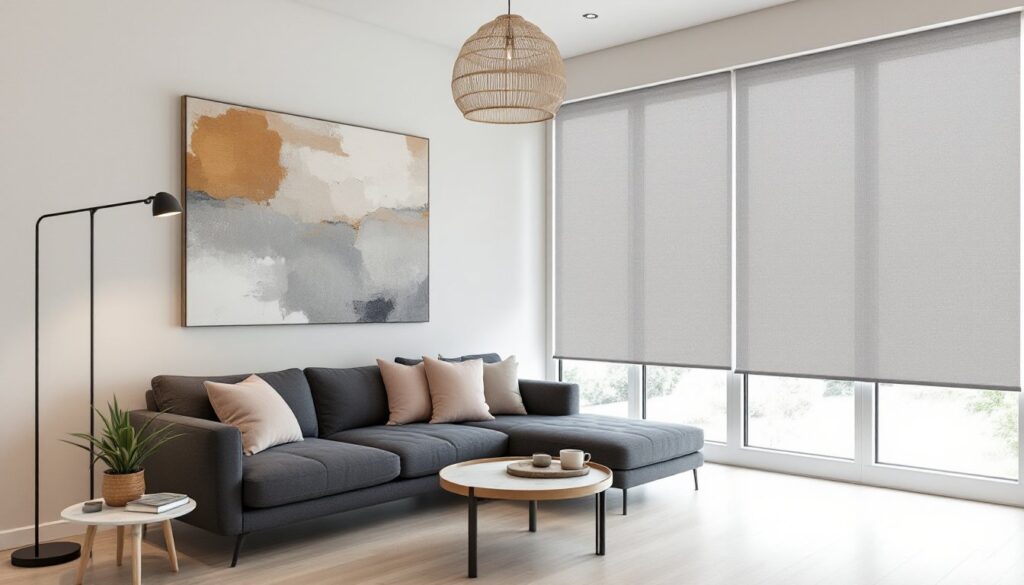
Roller blinds are the workhorse of modern window treatments. They consist of a single piece of fabric that rolls onto a tube mounted above the window. No cords, no slats, just a flat plane of material that disappears into a compact cassette when raised.
For living rooms, choose blackout roller blinds if the space doubles as a media room or if western sun causes screen glare. Blackout fabric is typically a triple-weave polyester with a reflective backing, providing near-total light blockage. If you prefer natural light during the day, opt for light-filtering or translucent roller fabrics that soften harsh sun without complete opacity.
Installation is straightforward: measure the window width (inside mount) or wall-to-wall span (outside mount), then mount the brackets with #8 screws into solid wood framing or use toggle anchors for drywall-only installations. Most roller kits include a spring-loaded or chain-pull mechanism. The chain should hang on the side opposite your dominant furniture layout to avoid snagging.
Color-wise, whites, grays, and taupes dominate modern living room window blinds for a reason, they’re timeless and versatile choices that won’t date your space. For a bolder look, charcoal or navy can add contrast against light walls without introducing pattern.
Sheer and Light-Filtering Blinds for Soft, Natural Ambiance
Sheer blinds, often called solar shades or sheer horizontal shades, use an open-weave fabric that filters UV rays while preserving outward views. They’re ideal if your living room overlooks a garden, courtyard, or cityscape you want to enjoy without sacrificing daytime privacy.
The openness factor is key: a 1% openness fabric blocks 99% of UV but still allows you to see outside clearly: a 10% openness lets in more ambient light and reduces the view slightly. For south- and west-facing windows, a 3–5% openness strikes the best balance between glare reduction and visibility.
One downside: sheer shades offer minimal nighttime privacy when interior lights are on. If that’s a concern, layer them with a secondary blackout roller or dual-roller system that mounts two fabrics on a single headrail. You operate them independently, sheer during the day, blackout at night.
Mounting is identical to standard rollers, but pay attention to bracket depth. Dual systems require a deeper cassette (typically 3–4 inches), which may interfere with window trim on shallow inside mounts. Measure your reveal depth before ordering.
Sheer fabrics come in neutral whites, soft grays, and even subtle metallics that catch light beautifully in contemporary spaces. They’re particularly effective in open-plan homes where consistent window treatments create visual continuity between living and dining areas.
Smart Blinds and Motorized Window Treatments
Motorized blinds have dropped in price significantly over the past five years. Battery-powered motors (using lithium-ion rechargeable packs) eliminate the need for hardwiring, making them a viable retrofit option for existing windows. Solar-rechargeable motors are also available and can run indefinitely on ambient indoor light, ideal for south-facing windows.
Integration with smart home systems (HomeKit, Alexa, Google Home, or dedicated hubs like Lutron Caseta) allows scheduling, voice control, and automation. Program your blinds for living room ideas like automatically lowering at sunset to reduce glare or raising at sunrise to wake the space naturally. Geofencing can trigger blinds to close when you leave home, adding a layer of security.
Installation varies by system. Most motorized roller blinds use the same bracket mounts as manual versions, with the motor housed in the roller tube. You’ll need to ensure the motor is on the correct side (typically opposite the window crank or doorway) for wire management. If you’re installing multiple blinds, consider a multi-channel remote or centralized wall switch.
One caution: motor noise. Cheaper motors can hum or click during operation. Look for units rated at 45 dB or lower, about as loud as a quiet conversation. If you’re retrofitting older roller blinds, confirm that aftermarket motors are compatible with your tube diameter (most standard tubes are 1.5 or 2 inches).
For large or high windows, motorization isn’t just convenience, it’s practical. A 10-foot-wide roller blind can weigh 15–20 pounds and require awkward reaching. Motors eliminate that hassle entirely.
Textured and Layered Blinds for Depth and Visual Interest
If flat roller blinds feel too stark, woven wood blinds and roman shades add organic texture without sacrificing modern lines. Woven woods are constructed from bamboo, reedgrass, or jute and mounted on a roll-up mechanism similar to rollers. They filter light through natural gaps in the weave, creating dappled patterns on walls and floors.
These work especially well in living rooms with natural fiber rugs, linen upholstery, or wood accent walls. The material provides warmth and depth that contrasts with sleek metal fixtures and glass surfaces. Note that woven woods offer limited light control compared to fabric blinds, expect about 30–50% light filtration even when fully lowered. For better room darkening, some manufacturers offer an optional privacy liner, a fabric backing that attaches with Velcro.
Roman shades offer a tailored, fabric-fold look that softens angular rooms. They’re available in flat-fold, hobbled, or relaxed styles. Flat-fold (also called flat roman) is the most modern, with crisp horizontal pleats that stack evenly at the top. Avoid fussy trims or tassels, stick with hidden seams and minimal hardware.
Layering is another strategy: mount sheer roller blinds on the window frame and add floor-length linen panels on a ceiling-mounted track several inches in front. This gives you three settings, sheers only, panels only, or both closed, and adds architectural depth. Just ensure your panels are stationary or on a simple baton draw: decorative tiebacks read traditional, not modern.
For installation, roman shades typically require inside mount to function correctly (the folds need clearance as they stack). Measure your window’s inside width at top, middle, and bottom, then use the narrowest measurement to avoid binding.
Choosing the Right Color and Material for Your Modern Living Room
Color selection depends on whether you want your blinds to recede or act as an accent. White and off-white fabrics reflect light, making small rooms feel airier and providing a neutral backdrop. If your walls are already white, consider a shade slightly warmer or cooler to avoid a flat, monochrome look.
Gray is the go-to for contemporary spaces. Light grays pair with almost any accent color and won’t show dust as readily as pure white. Charcoal or graphite works in high-contrast schemes, think white walls, dark trim, and black-framed furniture.
For warmer palettes, taupe, beige, or warm gray (sometimes called greige) complements wood tones and earth-toned upholstery. Avoid yellowed or cream shades unless your home leans traditional: they clash with the cooler whites used in modern paint and tile.
Material durability matters more in living rooms than bedrooms since UV exposure and frequent adjustments take a toll. Polyester fabrics resist fading and are easy to wipe clean with a damp microfiber cloth. Natural materials like linen or cotton blends look beautiful but may fade over 3–5 years on sun-drenched windows, consider UV-protective coatings if you go this route.
For homes with interior design focused on sustainability, look for blinds certified by GREENGUARD (low VOC emissions) or made from recycled PET fabrics. Some manufacturers now offer compostable woven wood blinds, though longevity is shorter than synthetic options.
Texture can also influence color perception. A smooth roller fabric in charcoal will read darker than a lightly textured linen weave in the same hue. Order fabric samples before committing, and view them in your living room at different times of day, morning and afternoon light can shift tones dramatically.
Conclusion
Modern living room blinds don’t have to be complicated. Start by defining your priorities, light control, privacy, energy efficiency, or aesthetics, then choose the style that addresses them without overcomplicating the install. Measure twice, order samples, and don’t skip the prep work on your mounting surfaces. Whether you opt for minimalist rollers, textured wovens, or smart motorized systems, the right blinds will work quietly in the background while making your living room more livable every single day.