Table of Contents
ToggleTight on square footage but tired of chopped-up rooms that feel even smaller? Removing walls between the kitchen and living room can transform a cramped house into a home that breathes. An open concept layout doesn’t just make a small house look bigger, it changes how the space works, letting natural light travel farther, sightlines open up, and conversations flow from stove to sofa without shouting through doorways. But tearing down a wall won’t automatically solve everything. Done poorly, you’ll end up with a bowling alley that lacks definition or a kitchen that broadcasts dirty dishes to everyone on the couch. The trick is planning zones, managing visual weight, and making smart choices about storage and furniture that keep the space functional without adding clutter.
Key Takeaways
- An open concept kitchen and living room layout reclaims 15-20% of your floor plan by eliminating hallways and doorways, making small houses feel larger and more functional.
- Strategic zoning without walls—using sofa placement, area rugs, kitchen islands, and layered lighting—creates distinct functional spaces while maintaining visual openness and natural light flow.
- Load-bearing walls require a structural engineer, building permit, and proper beam installation, while non-load-bearing walls are simpler to remove but need inspection for plumbing, HVAC, and electrical systems.
- Light, neutral wall colors combined with three layers of lighting (ambient, task, and accent) maximize perceived space and brightness in a small open plan kitchen living room.
- Smart storage solutions with floor-to-ceiling cabinets, hidden organizers, and multi-functional furniture prevent clutter that’s especially visible in open layouts and maintain an intentional design.
- Scaled furniture with legs rather than solid bases, strategic traffic flow planning, and a cohesive material palette (2-3 core colors, 1-2 wood tones) tie the kitchen, dining, and living zones together seamlessly.
Why Open Concept Layouts Work Perfectly for Small Houses
Small houses live and die by circulation. In a traditional layout, hallways and doorways eat up square footage without contributing much usable area. An open concept kitchen living room eliminates those dead zones, letting you reclaim 15-20% of your floor plan just by removing partition walls and trimming door swings.
Sightlines matter more than most people realize. When you can see from the front door to the back window, the brain reads the space as larger. That’s not decorating magic, it’s basic perception. Natural light compounds the effect. Instead of stopping at a wall, daylight from a living room window can reach into the kitchen, reducing the cave-like feel that kills smaller kitchens.
For families or anyone who entertains, a small open plan kitchen living room solves the isolation problem. The cook isn’t stuck facing a wall while everyone else gathers elsewhere. Kids doing assignments at the dining table stay visible from the stove. It’s a layout that matches how people actually use their homes, not how floor plans looked in 1950.
Structural reality check: Not every wall can come down. Load-bearing walls carry the weight of the floor or roof above. Removing one requires a properly sized beam (usually an LVL or steel I-beam) and posts to transfer the load. That means a structural engineer’s stamp, a building permit, and often a contractor with the equipment to set a heavy beam. Non-load-bearing partition walls are far simpler, usually just 2×4 framing and drywall, but you’ll still want to verify before swinging a sledgehammer. Check for plumbing, HVAC ducts, and electrical in the wall cavity. Relocating those systems adds cost fast.
Strategic Layout Planning for Your Open Kitchen and Living Room
An open floor plan without zoning is just an empty box. The goal isn’t to erase all boundaries, it’s to create defined areas that don’t need walls.
Creating Functional Zones Without Walls
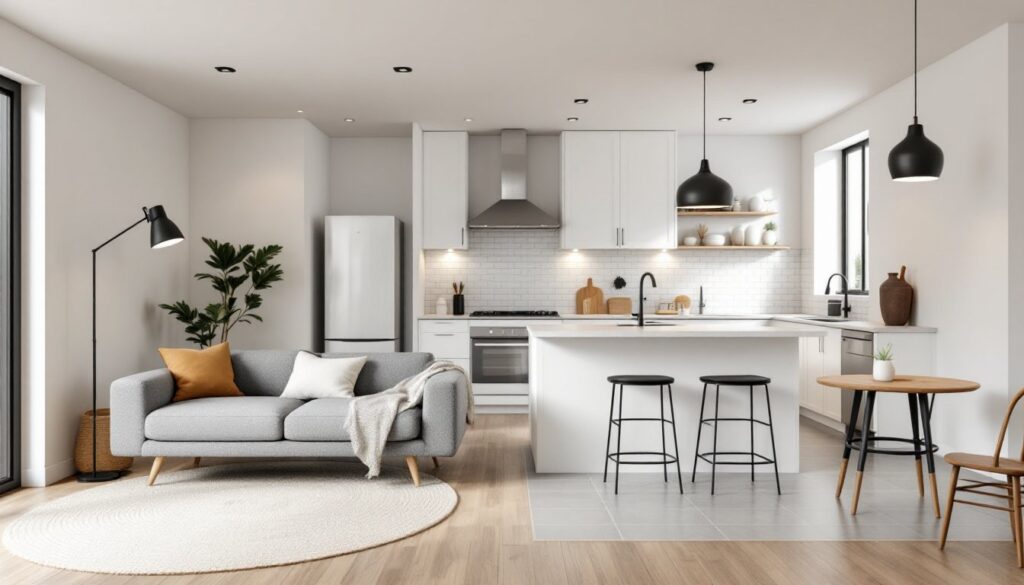
Start by anchoring each zone with its largest piece. In the kitchen, that’s the range and sink. In the living area, it’s the sofa. Position the sofa with its back toward the kitchen to create a subtle divider. This gives the living room a “back wall” without framing one and keeps sight lines open while signaling a shift in function.
Rugs are one of the cheapest and most effective zoning tools. A 6×9′ or 8×10′ area rug under the sofa and coffee table visually separates the living zone from the kitchen’s hard flooring. If the kitchen has tile and the living room has the same tile, the rug provides the contrast your eye needs to read them as distinct spaces.
Consider a kitchen island or peninsula as a physical boundary that doesn’t block light. A 4′-wide island with seating on the living room side creates a buffer, handles food prep, and adds storage. If space is tight, a peninsula extending from the existing counter achieves the same effect with less floor area. Both options work well in a very small open plan kitchen living room ideas scenario where every inch counts.
Ceiling treatments and flooring transitions can reinforce zones without adding bulk at eye level. A slight step down (if framing allows), a shift from tile to engineered hardwood, or even a change in ceiling height (if you’re remodeling with access to the structure) tells the brain “this is a different room” without physical separation.
Lighting also zones effectively. Pendant lights over an island or dining table define that area, while recessed cans provide ambient light in the living zone. Don’t rely on a single ceiling fixture to light the whole space, it’ll feel flat and institutional.
When planning your layout, browse small open concept kitchen ideas to see how others have tackled similar square footage challenges. Real projects often reveal solutions you won’t find in generic design advice.
Design Elements That Enhance Flow and Visual Space
Color and light do half the heavy lifting in a successful modern small open plan kitchen living room. Get them wrong, and even a well-planned layout feels cramped.
Color Schemes and Lighting Techniques
Light, neutral wall colors reflect more light and push walls back visually. White, soft gray, greige, or pale warm tones are safe bets. Flat or matte paints hide imperfections better than satin, but they’re harder to clean in a kitchen. Many DIYers compromise with matte on living room walls and satin or semi-gloss in the kitchen zone, keeping the color identical so the transition is invisible.
If you want color, add it through accents, throw pillows, a painted island base, or a feature wall behind the sofa. A single dark accent wall can add depth without shrinking the room, as long as the other three walls stay light.
Layered lighting is non-negotiable. Aim for three types:
- Ambient (overhead): Recessed LED cans on a dimmer, spaced roughly 4-6 feet apart. In kitchens, follow the “divide the ceiling height by two” rule for spacing (8′ ceiling = 4′ spacing).
- Task lighting: Under-cabinet LED strips for countertops, a pendant or two over the island, and a floor or table lamp near the sofa for reading.
- Accent lighting: Small picture lights, a lit bookshelf, or a strand of LEDs behind a floating cabinet add dimension after dark.
Natural light should drive your furniture layout. Don’t block windows with tall bookshelves or the back of a sofa. If privacy’s a concern, use sheer or top-down/bottom-up shades that let light in while blocking sightlines.
Mirrors and reflective surfaces amplify light. A large mirror on the living room wall opposite a window can double perceived brightness. Glossy subway tile backsplashes, stainless appliances, and glass-front cabinets all contribute. Don’t overdo it, too much reflection feels cold and commercial.
Smart Storage Solutions for Clutter-Free Living
Open concept means everything’s on display. Clutter that used to hide behind a closed kitchen door now announces itself to anyone on the couch. Storage has to work harder.
Floor-to-ceiling cabinets maximize vertical space and draw the eye up, making the room feel taller. If you’re renovating, box in the space above existing uppers to create a seamless column of storage. That 12-18″ gap above standard 30″ or 36″ wall cabinets is wasted potential.
Pull-out organizers inside base cabinets, pot and pan dividers, spice racks, trash pullouts, keep counters clear. A tidy counter is the single biggest factor in making an open kitchen look intentional rather than chaotic.
In the living zone, furniture with hidden storage keeps the space from feeling like a garage sale. Ottomans with lids, coffee tables with lower shelves, and console tables behind the sofa all add function. Floating shelves look clean but require discipline, three well-styled items beat twelve random objects every time.
A small pantry cabinet or a narrow 12″ or 15″-deep pullout next to the fridge can hold dry goods without protruding into traffic lanes. If you don’t have room for a pantry, consider a tall cabinet with rollout shelves instead of fixed shelving. You’ll actually use the back of the cabinet instead of losing cans in the dark.
Professionals who focus on kitchen organization systems often recommend the “one in, one out” rule for small spaces: every new item means an old one leaves. It’s not a design trick, but it’s the only way to keep an open layout from becoming a junk display.
Furniture Selection and Placement Tips
In a small kitchen and living room ideas scenario, every piece of furniture has to earn its footprint.
Scale matters. A big sectional might be comfortable, but in a 12×16′ combined space, it’ll dominate and block circulation. A standard three-seat sofa (around 84″ long) plus a chair or two usually works better. Measure before you buy. Leave at least 30-36″ of clearance for walkways, less feels tight, especially when someone’s carrying a hot pan from the stove.
Furniture with legs (rather than solid bases) looks lighter and lets more floor show through, tricking the eye into seeing more space. A sofa on 4″ legs beats a skirted one every time in a small room.
Multi-function pieces stretch your square footage. A dining table that doubles as a workspace, nesting side tables, or a sleeper sofa for guests all reduce the need for extra furniture. An extendable dining table can shrink to 36″ for daily use and expand to 60″ when you have company.
Floating furniture away from walls, even just 6-12″, can make the layout feel more intentional and less like you shoved everything to the perimeter. The sofa floats to create the zone, the dining table centers under a pendant, and negative space does as much work as the furniture itself.
Avoid blocking the kitchen work triangle (sink, stove, fridge). If the path from fridge to stove forces you to walk around the dining table and a chair, you’ve placed furniture in the workflow. Test traffic patterns by walking through meal prep scenarios before committing to a layout.
For homeowners documenting their transformations, many find inspiration in before-and-after room makeover projects that show real constraints and real solutions, not just styled magazine shots.
In an open concept living room dining room kitchen where all three functions share one space, a cohesive material palette ties it together. If the kitchen cabinets are white shaker style, consider white or light wood for the dining chairs. If the island is a bold navy or charcoal, echo that color in throw pillows or a living room accent piece. Repeating 2-3 core colors and 1-2 wood tones keeps the space from feeling like a furniture showroom.