Table of Contents
ToggleSide tables are the workhorses of the living room, they hold drinks, lamps, remotes, and everything else within arm’s reach. But they’re also prime real estate for styling. Done right, side table decor ideas for the living room can tie together an entire space, balancing function with visual interest. Done wrong, they become cluttered catch-alls that make a room feel messy and unfinished. This guide walks through the essential principles and seven proven approaches to styling side tables, whether someone’s working with a mid-century modern setup, a farmhouse aesthetic, or something in between.
Key Takeaways
- Living room side table decor works best when it balances function with visual interest, using 3–5 intentional objects rather than cluttering the surface.
- Layer items at varying heights (tall, mid, and low) and mix textures like ceramic, brass, wood, and natural fibers to create visual depth and prevent a generic look.
- A well-styled side table includes three foundational elements: proportional task lighting, a secondary object with contrasting form, and a tray to corral smaller items and create visual boundaries.
- Avoid common mistakes like overcrowding surfaces, using oversized lamps, blocking usability with decor, or matching everything—coordinate your palette but vary specific objects for personality.
- Adapt side table decor to your table’s material: glass tables need visual weight, wood tables pair with metal accents, and metal tables can handle bold colors and patterns without looking cluttered.
- Try seasonal rotation by keeping a core setup year-round and swapping one or two accent pieces to keep your living room feeling current without a full redesign.
Why Side Table Styling Matters in Your Living Room
Side tables sit at eye level when someone’s seated on the sofa or chair, which means they’re constantly in view. An unstylized or cluttered surface creates visual noise that detracts from the rest of the room, no matter how well the wall color or furniture placement works.
From a design standpoint, side tables anchor a seating area. They provide vertical interest and define the edges of a conversation zone. When styled intentionally, they reinforce the room’s aesthetic, whether that’s minimalist, maximalist, traditional, or eclectic. And because they’re small surfaces, they’re low-risk testing grounds for experimenting with color, texture, or seasonal accents without committing to a full room overhaul.
Functionally, side tables need to stay usable. A lamp, a coaster, space for a phone or book, these aren’t optional. The best side table decor ideas for living rooms balance aesthetics with real-world usability. If someone has to move three decorative objects to set down a coffee mug, the styling isn’t working.
Essential Elements of Side Table Decor
Every well-styled side table includes a few foundational elements that work together to create balance and visual interest. These aren’t rigid rules, but they provide a reliable framework.
Lighting is the most functional anchor. A table lamp with a shade that’s proportional to the base (typically a shade diameter two-thirds the height of the base) provides task lighting and fills vertical space. For small side tables, consider swing-arm wall sconces mounted above to free up surface area.
A secondary object adds personality, this might be a small plant, a sculptural piece, a stack of two to three books, or a decorative box. The key is choosing something with a different form than the lamp. If the lamp is cylindrical, a square tray or rectangular stack of books provides contrast.
A tray or small dish corrals smaller items (remotes, coasters, reading glasses) and creates a visual boundary that prevents the table from looking chaotic. Brass, wood, or ceramic trays work across most styles: avoid plastic or flimsy materials that cheapen the overall look.
Layering Heights and Textures
Layering is what separates a styled surface from a random collection of objects. The goal is to create three distinct height levels using items of varying scale.
Tall elements (12–24 inches above the table surface) include lamps, tall candlesticks, or stems in a vase. Mid-height elements (4–10 inches) might be a small plant, a stack of books, or a decorative object. Low elements (under 4 inches) are trays, coasters, or small bowls.
Texture adds depth without requiring more objects. Pair a smooth ceramic lamp base with a linen shade, a rough-hewn wood tray, and a soft velvet book cover. Mixing materials, metal, glass, natural fiber, stone, keeps the eye engaged. Avoid matching sets: they read as generic and lack the nuance that makes living room decor feel intentional.
Leave negative space. A side table shouldn’t be filled edge-to-edge. Aim to cover roughly 50–70% of the surface, leaving room for functional items and visual breathing room.
7 Stylish Side Table Decor Ideas You Can Try Today
1. The Minimalist Approach
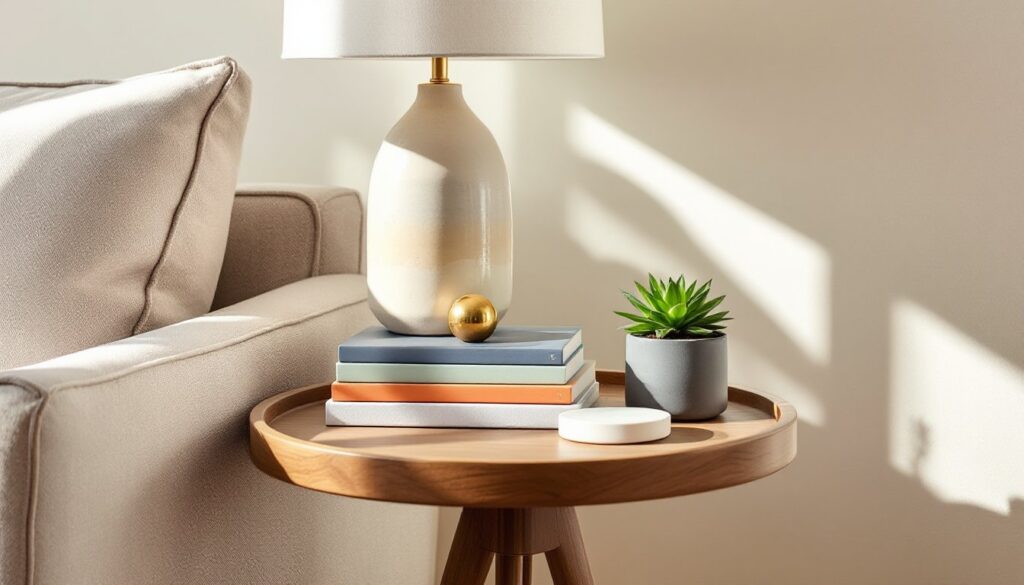
One ceramic or brass lamp with a simple drum shade, a single hardcover book, and a small succulent in a neutral pot. Total item count: three. This works best on small side tables (16–20 inches in diameter) or in rooms with bold wall treatments where the table shouldn’t compete for attention.
2. The Book Stack + Tray Combo
Stack three books (largest on bottom, smallest on top) with complementary spines, skip matching colors, but aim for tones that work with the room palette. Top with a small object: a geode, a decorative sphere, or a travel trinket. Add a wood or metal tray to hold a candle and coaster. This setup balances vertical and horizontal elements without requiring a lamp if overhead or floor lighting is sufficient.
3. Organic Texture Focus
Use natural materials to warm up modern or neutral spaces. A ceramic lamp with a reactive glaze, a small potted fern or trailing pothos, and a woven basket tray create a layered, tactile look. This approach suits living room end table decor in coastal, Scandinavian, or modern farmhouse interiors.
4. The Symmetrical Pair
For flanking a sofa, style both side tables identically or with mirrored elements. Matching lamps anchor the setup: vary the secondary objects slightly (one table gets a plant, the other a stack of books) to avoid a hotel-lobby feel. Symmetry creates visual calm and works well in traditional or transitional spaces.
5. The Collector’s Display
Group 3–5 small objects with a unifying theme, vintage brass animals, a collection of small ceramic vases, or a set of art glass paperweights. Arrange them on a tray to prevent the display from looking scattered. This works when the side table isn’t doing heavy functional lifting and the homeowner wants to showcase personal style without committing to large-scale decor changes.
6. The Functional Hybrid
Combine a swing-arm task lamp (mounted on the wall or clipped to the table edge) with a wireless charging pad embedded in a leather or wood tray, a small dish for keys or earbuds, and a single stem in a bud vase. This setup prioritizes usability without sacrificing style, ideal for side tables next to reading chairs or desks.
7. Seasonal Rotation
Keep a core setup (lamp + tray) year-round and swap one or two accent pieces seasonally. Spring: fresh tulips in a ceramic vase. Summer: a bowl of decorative spheres in blues and greens. Fall: a small pumpkin or brass candlestick with a taper. Winter: a pine sprig and pinecones in a vintage jar. Seasonal touches keep living room side table decor ideas feeling current without requiring a full redesign.
Choosing the Right Decor for Your Side Table Style
The side table’s form and finish should guide decor choices. A glass or acrylic side table benefits from objects with visual weight, a solid brass lamp, a chunky ceramic planter, to anchor the transparent surface. Lightweight or delicate items can look unmoored on glass.
Wood side tables (walnut, oak, reclaimed pine) pair well with mixed materials. Use metal accents (brass candlesticks, iron trays) or white ceramics to contrast the wood grain. Avoid all-wood or all-neutral setups: they flatten out and lose definition.
Metal side tables (hairpin legs, brass drum tables, iron bases) handle bold color and pattern better than wood. A bright ceramic lamp, a patterned book cover, or a vibrant plant pot adds energy without clashing. Keep the overall item count low: metal tables have strong geometry that competes with clutter.
Marble or stone tables read as formal. Stick to refined materials: polished brass, white or black ceramics, and greenery in simple pots. Rustic or overly casual elements (distressed wood, burlap, mason jars) create a style conflict.
Scale matters. A 24-inch round side table can support a full lamp, tray, and plant setup. A narrow 10-inch console-style end table may only accommodate a slim lamp and a single small object. Don’t force a full styling treatment onto a table that doesn’t have the footprint. Sometimes, following design inspiration from professionals helps clarify what works for specific dimensions.
Common Side Table Styling Mistakes to Avoid
Overcrowding the surface. More than five objects on a side table starts to look chaotic, especially on smaller surfaces. Edit ruthlessly. If something isn’t functional or doesn’t add visual interest, remove it.
Ignoring lamp proportions. A lamp that’s too tall throws off the room’s scale and creates glare when seated. The bottom of the shade should sit at or just below eye level when someone’s on the sofa. For a standard 24-inch seat height, that puts the lamp around 26–30 inches tall total (base plus shade).
Using decor that blocks usability. A side table is a landing zone, not a display shelf. If the styling makes it difficult to set down a glass or charge a phone, it’s not working. Leave at least a 6-inch diameter circle of open surface.
Matching everything. Matchy-matchy setups (identical lamps, identical trays, identical plants on each side table) lack personality and read as catalog staging. Coordinate the overall palette and style, but vary the specific objects.
Forgetting about cords. Lamp cords snaking across the floor or dangling off the table edge undermine otherwise polished styling. Use cord clips, run cords along the table legs, or route them behind furniture. For battery-operated or cordless lamps, make sure they’re recharged regularly, a dead lamp is worse than no lamp.
Neglecting dusting access. Intricate groupings of small objects create dust traps that are a pain to clean. If the styling makes routine dusting a chore, it won’t stay looking good. Choose pieces that can be quickly lifted and wiped underneath.
Conclusion
Side table decor doesn’t require a design degree or a big budget, just attention to scale, balance, and function. Start with the essentials (lighting, a tray, one or two accent pieces), edit down to what actually fits the surface, and adjust from there. The best living room side table decor ideas are the ones that look intentional but still leave room for a coffee mug.