Table of Contents
ToggleThe trailer is the foundation of every tiny home build, literally. Unlike traditional houses that sit on concrete slabs or crawl spaces, a tiny house on trailer relies on a steel chassis to bear the load, handle road transport, and provide structural integrity for decades. Pick the wrong trailer and you’ll fight alignment issues, weight problems, and potentially unsafe road conditions. Choose the right one, and your build starts on solid footing. This guide walks through the features, sizes, costs, and decision points that matter when selecting a tiny house trailer, so builders can move forward with confidence.
Key Takeaways
- A tiny home trailer must be engineered with reinforced frame members, upgraded axles, and DOT-compliant brake systems to safely support a permanently mounted dwelling and handle road transport.
- Gross Vehicle Weight Rating (GVWR) should match your finished build weight—typically 10,000–15,000 pounds for most tiny homes—requiring careful calculation of lumber, appliances, plumbing, and occupants plus a 20% safety buffer.
- A purpose-built tiny house trailer costs $4,000–$7,000 for standard 20–24 foot dual-axle models, with additional expenses for delivery, titling, leveling jacks, and towing equipment that can reach $500–$1,500 combined.
- Trailer size and configuration should match your floor plan and desired layout, with 16–18 foot models ideal for minimalists, 20–24 feet offering the best balance for most builds, and 26–28 feet suited for families or extra living space.
- RVIA or NOAH certification ensures your tiny home trailer meets legal and insurance requirements for towable dwellings, making compliance critical before construction begins.
- Low-profile trailers maximize interior ceiling height without exceeding the 13-foot 6-inch highway height limit, while gooseneck designs offer creative floor plans but require truck-bed hitches and sacrifice maneuverability.
What Is a Tiny Home Trailer and Why Does It Matter?
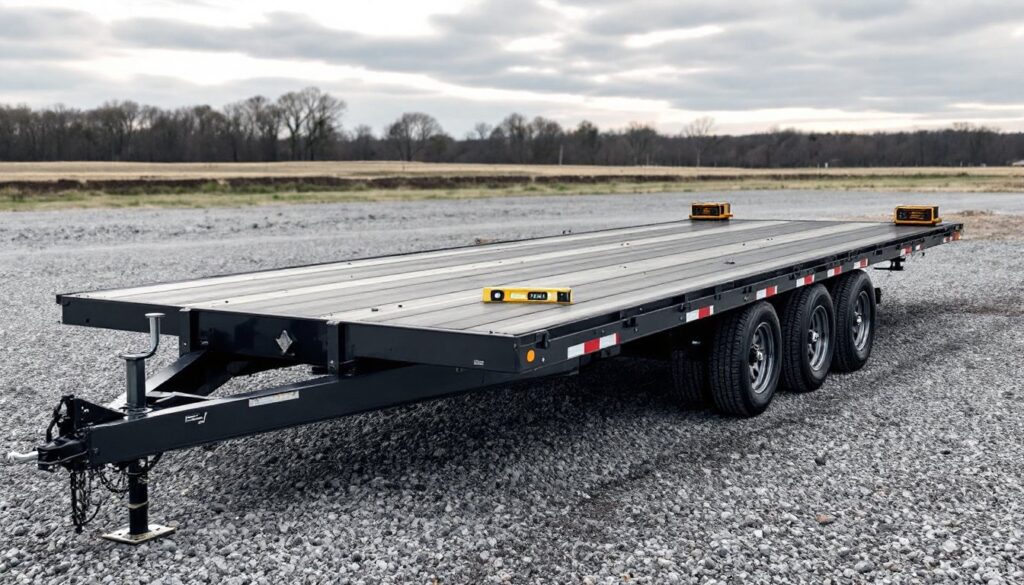
A tiny home trailer is a specialized flatbed chassis engineered to support a permanently mounted dwelling, not just haul cargo for a weekend. These trailers differ from standard utility trailers in several critical ways: they feature reinforced frame members to handle continuous live loads, upgraded axles rated for long-term weight, and often include RV-style tongue jacks and brake systems compliant with Department of Transportation (DOT) standards.
The trailer serves as both the foundation and the transportation mechanism. It must distribute the weight of walls, roof, utilities, and furnishings without sagging or twisting. A poorly spec’d trailer can lead to cracked drywall, misaligned doors, and structural failure during transport. Worse, an overloaded or improperly rated trailer poses serious safety risks on the highway.
Most tiny house trailers are built to RVIA or NOAH certification standards, meaning they meet minimum safety and construction benchmarks for towable dwellings. This matters for insurance, financing, and legal classification in many jurisdictions. If you plan to move your tiny house more than once, or ever need to insure it as an RV, starting with a code-compliant trailer frame is non-negotiable.
Key Features to Look for in a Tiny Home Trailer
Not all tiny house trailers are created equal. Understanding the core features helps builders match the chassis to the build plan and avoid costly retrofits down the line.
Weight Capacity and Load Distribution
Gross Vehicle Weight Rating (GVWR) is the maximum loaded weight the trailer can safely carry, including the trailer itself. Most tiny homes weigh between 8,000 and 14,000 pounds when finished, so a trailer rated for 10,000–15,000 pounds GVWR is typical. Don’t just add up your lumber and call it done, account for sheathing, siding, roofing, appliances, plumbing, furniture, and occupants.
Axle configuration matters for load distribution. Dual-axle trailers (two axles with four wheels total) are standard for homes over 20 feet. Triple-axle setups handle heavier builds or those with concentrated weight, like masonry siding or a second loft. Trailer manufacturers often use torsion axles for tiny homes because they offer independent suspension, a smoother ride, and better clearance than leaf-spring setups.
Pay attention to tongue weight, the downward force at the hitch. It should be 10–15% of total trailer weight for safe towing. Too little and the trailer sways: too much and it overloads the tow vehicle. Many tiny house trailers include adjustable hitches or extended tongues to help balance this.
Frame Material and Construction Quality
Most tiny house trailer frames are built from steel tubing, typically 3×4-inch, 4×6-inch, or 6×6-inch rectangular sections depending on length and load. Wall thickness (often 3/16-inch to 1/4-inch) affects rigidity and rust resistance. Powder-coated or galvanized finishes add longevity, especially in wet climates.
Look for full-perimeter framing with cross members spaced every 12 to 16 inches on center. This mimics floor joist spacing in conventional construction and provides solid attachment points for subfloor sheathing. Some trailer tiny home frames include welded steel outriggers that extend beyond the main frame to support roof overhangs or porch extensions.
Brake systems are legally required on trailers over a certain weight, typically 3,000 pounds in most states. Electric drum brakes on all axles are standard, with a breakaway system that engages brakes if the trailer detaches from the tow vehicle. Verify that the wiring harness includes a seven-pin connector compatible with most tow vehicles.
Popular Tiny Home Trailer Sizes and Configurations
Tiny house trailers typically range from 16 to 28 feet in length, with widths of 8 feet 6 inches being the maximum for highway travel without special permits in most states. Here’s how common sizes break down:
- 16–18 feet: Ideal for solo builders or minimalists. These small tiny house trailers fit one loft, a compact kitchen, and a wet bath. GVWR usually falls between 7,000 and 9,000 pounds.
- 20–24 feet: The sweet spot for most builds. Enough room for a full kitchen, bathroom with shower, and one or two sleeping lofts. Dual axles are standard. GVWR ranges from 10,000 to 12,000 pounds.
- 26–28 feet: Larger layouts with more headroom, storage, or living area. Often used for couples or small families. Triple axles may be needed depending on weight. GVWR can exceed 14,000 pounds.
Deck height, measured from ground to top of frame, affects interior ceiling height and step access. Low-profile trailers sit closer to the ground (often 20–24 inches), giving you more interior vertical space without exceeding the 13-foot 6-inch highway height limit. Standard utility trailers often sit higher, eating into usable ceiling clearance.
Some builders opt for gooseneck trailers, which have a raised front section that extends over the tow vehicle bed. This allows for a ground-floor bedroom or storage area in the gooseneck, freeing up main-floor square footage. But, gooseneck tiny homes require a pickup truck with a bed-mounted hitch and are less maneuverable in tight spaces.
How to Choose the Right Trailer for Your Tiny Home Build
Start with your floor plan. Measure the exterior dimensions, including any overhangs, porches, or bump-outs, and add a margin for siding thickness and trim. The trailer should match or slightly exceed those dimensions. Don’t plan to cantilever more than 12 inches beyond the frame without engineering approval: it concentrates stress and can cause cracking.
Calculate your estimated build weight. Use a spreadsheet to tally:
- Framing lumber (dimensional weights are available online)
- Sheathing and siding
- Roofing materials
- Insulation
- Interior finishes (drywall or paneling)
- Cabinetry and appliances
- Water heater, tanks, plumbing fixtures
- Furniture and personal belongings
Add 20% as a safety buffer. Compare that total to trailer GVWR. If you’re close to the limit, consider a lighter build material, engineered lumber instead of solid framing, metal roofing instead of asphalt shingles, or composting toilet instead of a full blackwater system.
Decide whether you’ll move the home frequently or park it semi-permanently. If you plan to tow more than once or twice, invest in a trailer with upgraded suspension, LED lighting, and marine-grade wiring. If it’s a one-time move to a permanent site, a basic code-compliant frame may suffice.
Check local and state regulations. Some areas classify tiny homes on trailers as RVs, requiring RVIA certification. Others treat them as mobile homes, with different titling and parking rules. Confirm your trailer meets the legal definition before you build.
Budgeting for Your Tiny Home Trailer: Costs and Considerations
A purpose-built tiny house trailer frame typically costs $4,000 to $7,000 for a standard 20- to 24-foot dual-axle model. Factors affecting price include:
- Length and axle count: Longer trailers and triple-axle setups add material and labor costs.
- Customization: Integrated wheel wells, custom widths, or specialty finishes increase price.
- Certification: RVIA- or NOAH-certified trailers cost more but may be required for insurance or zoning compliance.
- Manufacturer reputation: Established builders with proven track records charge a premium, but warranty and support can be worth it.
Used tiny house trailers occasionally appear on the resale market, often from abandoned builds or downsizers moving into traditional housing. Inspect any used trailer for rust, frame cracks, bent axles, and bearing wear. A professional inspection (around $200–$400) can prevent expensive surprises.
Don’t forget ancillary costs:
- Delivery or pickup fees: Trailers are heavy and wide: shipping can run $500–$1,500 depending on distance.
- Titling and registration: Varies by state. Some require annual renewals, others offer permanent tags.
- Jacks and stabilizers: Budget $300–$800 for adjustable corner jacks to level the home on-site.
- Towing equipment: If your vehicle lacks a brake controller or weight-distribution hitch, add $400–$1,000.
Some builders attempt to modify standard utility or equipment trailers to save money. This can work for very light builds under 8,000 pounds, but often requires welding additional cross members, upgrading axles, and adding a compliant brake system. By the time you factor in labor and parts, the savings shrink, and you lose manufacturer warranties and certifications.