Table of Contents
ToggleRipping out tired kitchen cabinets can be the single best bang-for-your-buck renovation a homeowner tackles. But selecting the right replacements, and figuring out where to buy them, often feels like navigating a lumber yard in the dark. Home Depot has quietly become one of the largest kitchen cabinet retailers in North America, offering a range that spans budget-conscious stock units to semi-custom builds that rival specialty showroom pricing. Whether you’re planning a weekend refresh or a full gut-and-rebuild, understanding what’s available at your local store, and how to navigate specs, measurements, and installation, can save thousands of dollars and weeks of frustration.
Key Takeaways
- Home Depot kitchen cabinets offer availability, price transparency, and same-day stock options that rival custom cabinet shops with 8–12 week lead times.
- Stock cabinets cost $75–$150 per linear foot, semi-custom runs $150–$350, and custom starts at $400+—choose based on budget, timeline, and design flexibility needs.
- Accurate measurements and a detailed kitchen layout are critical; sketch your kitchen, locate studs, and account for filler strips to avoid costly returns and installation errors.
- DIY installation of stock or RTA cabinets can save 40–60% on labor but requires proper tools, a helper, and weekend-long commitment; hiring professionals costs $75–$150 per linear foot.
- A realistic 20-linear-foot kitchen renovation ranges from $3,000–$6,000 (stock) to $7,000–$14,000 (semi-custom), with hidden costs including delivery, countertops, and plumbing modifications.
- Popular styles include Shaker (clean, versatile), raised-panel (traditional), and slab doors (contemporary), with durability varying by finish—thermofoil resists moisture but can delaminate, while painted finishes hold up better to scrubbing.
Why Choose Home Depot for Your Kitchen Cabinet Project
Home Depot dominates the big-box kitchen cabinet market for good reason. First, availability: most metro stores keep a rotating stock of ready-to-assemble (RTA) and pre-assembled cabinets on-site, meaning you can walk out same-day with base units, wall cabinets, and filler strips. Compare that to custom cabinet shops, where lead times can stretch eight to twelve weeks.
Second, price transparency. Home depot kitchen cabinets sale events run quarterly, often timed to Memorial Day, Labor Day, and Black Friday. Discounts typically range from 15–30% on select lines, and the website lists SKUs, dimensions, and pricing in real time, no need to haggle or wait for a quote.
Third, integration with installation services. Home Depot contracts licensed installers in most ZIP codes: you can bundle cabinetry, countertops, plumbing hookups, and even disposal of your old units under one estimate. That’s especially valuable if you’re managing a kitchen remodel solo and don’t want to coordinate three separate trades.
Finally, the return policy. Unopened cabinets can be returned within 90 days (180 days for Pro Xtra members), and damaged units are typically swapped on-site or credited within 48 hours. That flexibility matters when you discover a shipping error mid-install or need to adjust quantities after final measurements.
Exploring Home Depot’s Kitchen Cabinet Collections
Home Depot organizes its inventory into three tiers, each serving different budgets and timelines. Understanding the distinctions prevents buyer’s remorse and helps match cabinets to your project scope.
Stock vs. Semi-Custom vs. Custom Cabinet Options
Stock cabinets are pre-manufactured in standard widths (12″, 15″, 18″, 24″, 30″, 36″) and sold as-is. Popular brands include Hampton Bay and Continental Cabinets. These units ship flat-packed or pre-assembled, and most are constructed from MDF cores with thermofoil or melamine finishes. Expect face-frame construction (a traditional American cabinet style) and 3/4″ plywood or particleboard box sides. Stock cabinets typically cost $75–$150 per linear foot installed, making them the go-to for tight budgets and fast turnarounds. The trade-off: limited configuration options and fewer premium wood species.
Semi-custom cabinets offer more flexibility. Brands like Thomasville and Diamond NOW let you tweak widths in 3″ increments, select drawer configurations, add soft-close hinges, and choose from a broader palette of stains and paints. Construction quality steps up, expect plywood box construction, dovetail drawer joints, and full-extension undermount slides on many models. Pricing runs $150–$350 per linear foot. Lead time: two to four weeks for most orders. Semi-custom is the sweet spot for homeowners who want a tailored look without the price tag of a bespoke millwork shop.
Custom cabinets are built to exact specifications. Home Depot partners with manufacturers that fabricate units to the nearest 1/16″, accommodate non-standard ceiling heights, and offer exotic hardwoods (cherry, walnut, quartersawn oak). These projects require in-home consultations, CAD drawings, and longer lead times, often six to ten weeks. Costs start around $400 per linear foot and climb quickly. Custom makes sense for historic homes, oddball floor plans, or clients who demand specific joinery details.
Popular Cabinet Styles and Finishes Available
Shaker-style doors dominate sales at home depot cabinets kitchen aisles in 2026. The clean, recessed-panel design works equally well in farmhouse, transitional, and modern kitchens. White and gray remain top sellers, but demand for warm neutrals, greige, taupe, sage, is rising as homeowners move away from stark contrast.
Raised-panel cabinets appeal to traditional tastes. These feature a center panel that projects beyond the frame, adding visual weight. Common finishes include cognac, espresso, and cherry natural. Be aware: raised panels show dust and fingerprints more readily than flat or recessed designs.
Slab (flat-panel) doors anchor contemporary and Scandinavian kitchens. Home Depot’s slab options often come in high-gloss lacquer, matte thermofoil, or natural wood veneer. They’re the easiest to clean but offer no forgiveness for installation errors, any twist in the door or misaligned hinge is immediately visible.
Finish durability matters. Thermofoil and laminate resist moisture well but can delaminate near dishwashers or cooktops if seams aren’t caulked. Painted wood cabinets (catalyzed conversion varnish finishes) hold up better to scrubbing but cost more. Stained wood shows character, and scratches, over time: plan to touch up high-traffic areas every few years.
How to Measure and Plan Your Kitchen Cabinet Layout
Accurate measurements prevent costly returns and mid-project scrambles. Start by sketching your kitchen footprint on graph paper (1/4″ = 1′ scale) or using Home Depot’s free online kitchen planner tool, which auto-generates 3D renderings and materials lists.
Step 1: Measure walls. Record length in inches at countertop height (36″ above the finished floor), not at baseboard level, walls are rarely plumb. Note window and door trim, electrical outlets, and any HVAC vents. Mark the centerline of your sink plumbing and the gas/electric supply for your range.
Step 2: Identify structural obstacles. Locate studs using a stud finder: you’ll anchor wall cabinets to these. Check ceiling height, standard wall cabinets are 30″, 36″, or 42″ tall, and decide whether to run cabinets to the ceiling (requires filler or crown molding) or leave open space above.
Step 3: Plan your layout sequence. Start with corner units (lazy Susans or blind-corner pull-outs), then work outward. Base cabinets are typically 24″ deep and 34.5″ tall (add a 1.5″ countertop to reach the standard 36″ work height). Wall cabinets are usually 12″ deep and hung 18″ above the countertop. Leave at least 15″ clearance between the cooktop and any overhead cabinet.
Step 4: Account for filler strips. Cabinets come in fixed increments: if your wall measures 127″ but your cabinet run totals 124″, you’ll need a 3″ filler to bridge the gap and ensure doors clear adjacent walls or appliances. Fillers also let you scribe cabinets to uneven walls.
Pro tip: Measure twice, order once. If you’re unsure, bring your sketch and measurements to a Home Depot kitchen specialist for a free layout review. They’ll flag common errors, like forgetting a dishwasher panel or underestimating drawer-stack heights. Many homeowners find inspiration from online design galleries to visualize cabinet arrangements before committing to an order.
Installation Options: DIY vs. Professional Services
Installing homedepot kitchen cabinets yourself can cut labor costs by 40–60%, but it demands patience, a second pair of hands, and the right tools. Here’s what to consider.
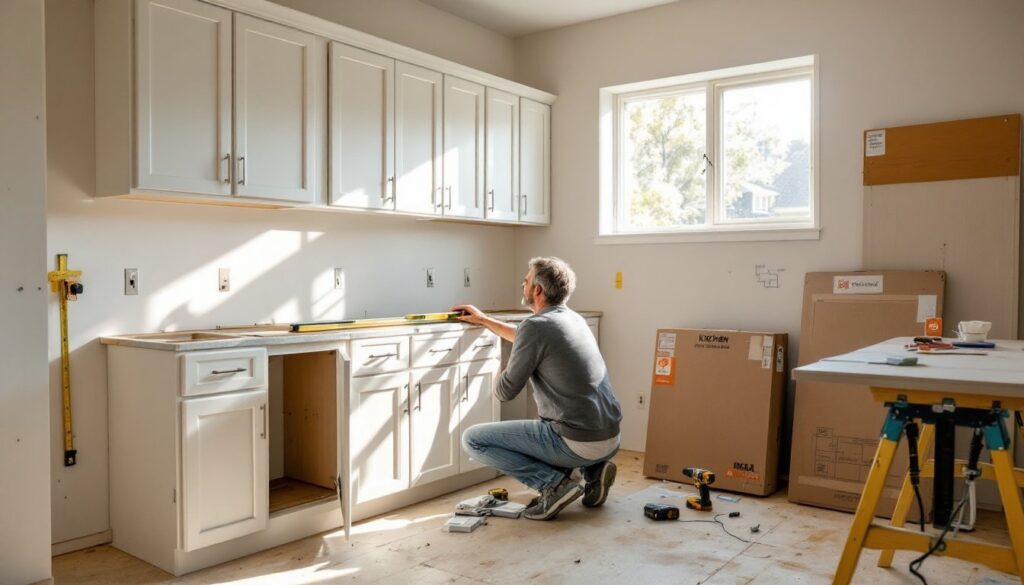
DIY installation is feasible for stock or RTA cabinets if you’re comfortable with a 4′ level, cordless drill, and cabinet screws (#8 x 2.5″ for face-frame attachment). You’ll need a stud finder, shims, and a scribe tool to fit cabinets against uneven walls. Budget a full weekend for a standard 10′ × 10′ kitchen (twenty linear feet of cabinets). Wall cabinets go up first, hang a ledger board at 54″ above the floor to support units while you level and fasten them. Anchor into at least two studs per cabinet: drywall anchors alone won’t hold the weight of dishes and canned goods.
Base cabinets follow. Set them in place, shim to level (front-to-back and side-to-side), then clamp adjacent units together and drill pilot holes through the face frames before driving screws. Don’t skip the clamps, misaligned face frames create visible seams and doors that won’t close flush.
Professional installation through Home Depot includes cabinet assembly (if needed), leveling, anchoring, and attachment of knobs/pulls. Installers also handle scribing, filler cuts, and coordination with countertop templaters. Typical labor runs $75–$150 per linear foot, depending on region and complexity (islands, crown molding, and under-cabinet lighting add to the bill). If you’re also replacing flooring, plumbing, or electrical, hiring a licensed contractor ensures permit compliance and avoids sequencing headaches.
One middle-ground option: assemble cabinets yourself (saving the assembly fee), then hire pros for the hang. Many installers will do this on a per-unit or hourly basis ($50–$90/hour in most markets).
Safety note: Wall cabinets are heavy, a loaded 36″ unit can weigh 80+ pounds. Always wear safety glasses when drilling overhead, and use a cabinet lift or helper to position units. Never stand on countertops: rent a sturdy step ladder or platform.
Budgeting for Your Home Depot Kitchen Cabinet Renovation
Kitchen cabinet costs vary widely based on materials, finish, and add-ons. Here’s a realistic breakdown for a 150-square-foot kitchen (roughly 20 linear feet of cabinetry).
Stock cabinets: $1,500–$3,000 for materials. Add $1,500–$3,000 for professional installation, countertops (laminate or butcher block), and hardware. Total project cost: $3,000–$6,000. This tier suits rentals, flips, or starter homes.
Semi-custom cabinets: $3,000–$7,000 for materials. Installation and mid-grade quartz countertops bring the total to $7,000–$14,000. This is the most common range for owner-occupied homes aiming to balance aesthetics and resale value.
Custom cabinets: $8,000+ for materials alone. Full renovations (including high-end countertops, tile backsplash, lighting, and appliances) easily hit $25,000–$50,000 or more. Reserve custom for high-value homes or if you plan to stay put for a decade.
Hidden costs to budget for:
- Delivery fees: $75–$200 for home depot kitchen cabinets sale orders, depending on distance from the distribution center.
- Disposal: Hauling away old cabinets runs $150–$400 if not included in your install contract.
- Countertop templating and installation: $40–$100 per square foot for quartz or granite, with a $300–$500 template fee.
- Plumbing and electrical modifications: If you’re moving the sink or adding under-cabinet lighting, factor another $500–$2,000 for licensed trades.
- Permits: Some jurisdictions require permits for electrical or plumbing work, even in cosmetic remodels. Check local building codes.
Financing options: Home Depot offers 6-, 12-, and 24-month interest-free financing on purchases over $299 (subject to credit approval). Pro Xtra members get volume discounts and extended return windows. If you’re budgeting for a larger remodel, compare rates with a home equity line of credit (HELOC), which may offer lower APRs for multi-year payback.
Cost-saving tactics:
- Mix tiers: Use semi-custom for visible wall cabinets and stock for base units hidden behind an island or pantry door.
- Skip soft-close on every door: Install it only on high-traffic cabinets (sink base, utensil drawers).
- Buy floor models or returns: Home Depot’s clearance section often has lightly damaged or discontinued cabinets at 30–50% off. Inspect carefully for structural issues.
- Reuse existing hardware: If your old knobs or pulls are solid brass or quality metal, clean them up and save $2–$10 per piece.
For more ideas on styling and maximizing cabinet storage, many homeowners turn to kitchen design resources or explore remodel galleries to plan layouts that blend function with aesthetics. Also, coordinating with retailers that offer competing product lines can help benchmark pricing and quality.
Finally, don’t overlook the finishing touches. Once cabinets are installed, cabinet decor ideas like open shelving inserts, glass-front doors, or under-cabinet LED strips can elevate the look without blowing the budget.